This story appears in the November–December 2026 issue of Dispense Times.
I’ve had to tell a patient we couldn’t fill their prescription. Most of us have. You get on the phone, call a few stores, and maybe somebody has it.
Sometimes that medication is sitting on another pharmacy’s shelf as surplus, with no plan to move it before it expires. Most of us have some of that stock ourselves.
The year-end count is a good time to deal with it. You’re already handling every bottle, and moving surplus in December, while the dating is still good, gives it the best chance of reaching a patient who needs it. It also puts cash back in the store, which matters, but the patient is the reason to do it now rather than in the spring.
Why December
You’re counting anyway. Getting eyes on surplus is the hard part, and the count does that for you. Add a column to the count sheet for whether it moved in the last 90 days and you’ve got your surplus list without a separate project.
Dating is the other reason. Ten months left in December is seven in March. A lot of buyers won’t take anything under six months, and a patient starting therapy needs enough dating to get through the fill. The longer it sits, the fewer people can use it.
Get every issue of the Dispense Times digital magazine free. Sign up below.
January also brings a new plan year, with formulary changes, prior authorizations starting over, and patients switching therapies. That creates new surplus early in the year, and it helps to have this year’s cleared out before it arrives.
Also worth knowing: FDA has exempted small dispensers from the electronic, interoperable requirements of the Drug Supply Chain Security Act (DSCSA) until November 27, 2027. That’s about a year out. Getting a documented surplus routine going this winter is an easy way to practice for it.
How to work the list
Start simple: anything that hasn’t moved in 90 days, plus anything dating inside twelve months. For most stores that list is shorter than you’d expect and worth more than you’d expect, especially on brand.
For each line you only need four things: NDC, quantity, expiration date, and what you paid. That’s enough to make every decision that follows.
Pull two groups out right away. Controlled substances have their own DEA transfer rules, and your board may add more, so they get their own track. Refrigerated product can still be recovered, but it needs validated packaging and a temperature record from the moment it leaves your hands. Sort that out before you plan to move it, not after.
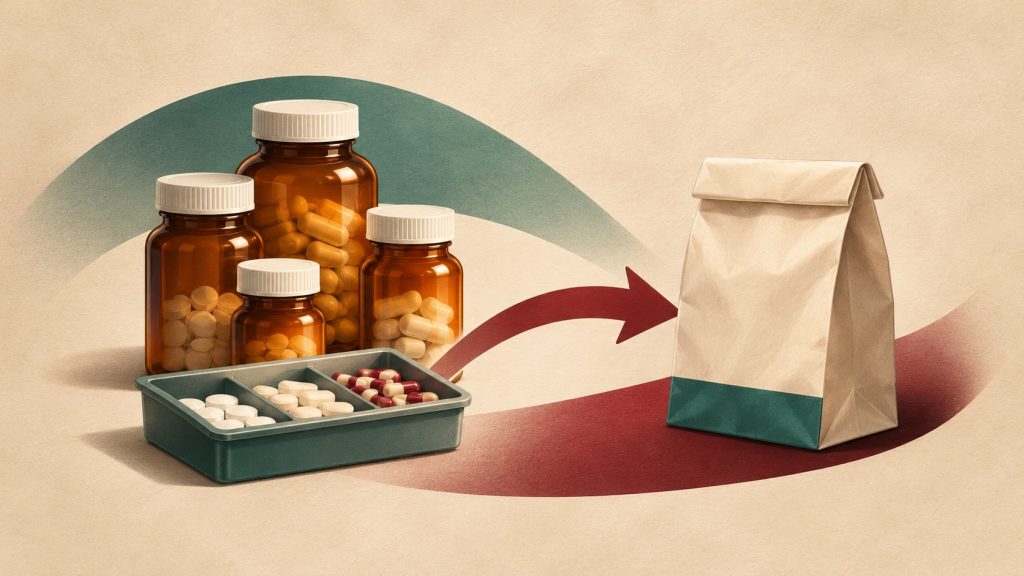
Then every line goes into one of four piles, in this order.
- Keep it. Before anything leaves the building, ask whether one of your own patients is going to need it. That bottle on the surplus list might be the next refill for someone you’ve filled for ten years. Your patients come first.
- Send it back to the wholesaler. If it qualifies, this is the cleanest path. Return policies vary a lot by manufacturer and sometimes by contract: dating windows, restocking fees, what qualifies at all. Specialty, refrigerated, and short-dated items are the usual exclusions, so read the policy instead of assuming.
- Sell or transfer it to another pharmacy. For in-date, salable product that can’t go back, another pharmacy may need exactly that NDC. It’s the option owners use least. Done well, it usually returns more than a reverse distribution credit, and sooner. It’s also the option that sends the medication to a patient instead of destruction.
- Reverse distribution. Expired, recalled, damaged, and otherwise non-salable product belongs here, full stop. That’s what reverse distribution is for: destroying it properly and documenting it. It isn’t built to recover value on in-date product. Credits can take weeks or a quarter, and the fees come off the top.
Short-dated product only helps a patient if it can be dispensed and used before it expires, so be realistic about the dating a buyer and their patient can work with. That’s another reason to sort in December rather than March.
Doing it by the book
Selling surplus to another pharmacy is a regulated transaction. Here’s what’s worth knowing before you list anything.
When you buy from or sell to another pharmacy to restock, DSCSA applies. There is one exemption, and it is narrower than it sounds: a transfer from one pharmacy to another to fill a prescription for an identified patient. That’s the phone call from the top of this article. The statute expressly excludes transfers made to replenish stock in anticipation of a potential need, so selling your year-end surplus falls in a different category from helping a colleague fill one script tonight.
You may hear “T3.” It’s legacy shorthand for transaction information, transaction history, and transaction statement. The transaction history requirement ended on November 27, 2023, under § 582(k) of the FD&C Act. Transaction information and the transaction statement still apply, carrying the product identifier: standardized numerical identifier, lot number, and expiration date. FDA sets record retention at no less than six years from the transaction, whether your records live in a system or a filing cabinet.
Check your state, too. Pharmacy-to-pharmacy sales can be lawful when they follow federal and state requirements, but the rules aren’t the same everywhere. They can turn on the type of transaction, how often you do it, the volume, and the products involved. A call to your board, or a look at its published guidance, is worth ten minutes before you list a big year-end lot.
And know who you’re trading with. Whatever channel you use, make sure the buyer is a licensed pharmacy, then ask a few practical questions. Is there a transaction record on every trade, or do I have to chase it later? Can I export my own records without asking anyone, and how long are they kept? If a shipment shows up short or damaged, who fixes it? And the one owners tend to skip: if a PBM opens an inquiry eight months from now, am I putting that response together alone?
Ask to see a sample transaction record before you list anything. Anyone legitimate will show you one.
Making it a habit
A December cleanout is worth doing once. It’s worth a lot more as the start of a routine.
Pick a day and run the same 90-day and dating filter every month. Surplus you catch at ten months of dating has every option open. Catch it at three and there are fewer options.
Give it an owner. In most stores that’s a technician who keeps the list, with the pharmacist making the keep-or-move call. Ten minutes of decisions a month beats a whole afternoon in December.
Look before you order. When you’re short on something, another pharmacy’s surplus might be the fastest way to get it for your patient. It works in both directions.
And do the math on your own shelf. Pick five real NDCs and compare what a wholesaler return would credit, what reverse distribution would net, and what a direct sale would bring, plus how long each one takes. Cash this month is worth more than a credit next quarter. Your own numbers will tell you more than any industry average, including any I could give you.
A practical way to move it
Every pharmacy ends up with surplus, because nobody predicts demand perfectly. The difference is whether you deal with it on purpose or find it during an audit. Deal with it on purpose and you get cash back, and the medication gets to a patient instead of being destroyed.
The first stop should always be a return to your wholesaler, if the product qualifies. For what can’t go back, marketplaces built for pharmacy-to-pharmacy trading let you list surplus, see which licensed pharmacy is on the other side, and keep the transaction records with each trade. Whatever you use, look for:
- Licensed pharmacies only, and you can see which pharmacy is on the other side
- A transaction record on every trade
- Records you can export yourself, kept at least six years
- A clear answer on who fixes a short or damaged shipment
- Help if a PBM opens an inquiry months later
- A sample transaction record you can see before you list
Back to the patient
Instead of leaving medication on your shelves, turn your year-end count into a surplus review. What’s sitting in the back could be the exact medication a patient at another pharmacy needs, and most of us have made those calls looking for one. Sort it now, check it every month, and move it while the dating still works.
The cash back in your store matters, but the bigger result is a patient who leaves with their prescription filled.
Alex Toth, PharmD, is a pharmacist and the owner of Plumstead Pharmacy in New Jersey. Alex is also Chief Operating Officer of InStockRx, a marketplace where licensed U.S. pharmacies buy and sell prescription medication directly with one another, with 2,100+ pharmacies on the platform.
Sources
- FDA, DSCSA Product Tracing Requirements FAQs
- FDA, DSCSA Standards for the Interoperable Exchange of Information
- FDA, Product Tracing Requirements for Dispensers
- FDA, Exemptions under the DSCSA
Get every issue, free
Practical ideas for independent pharmacy owners, delivered to your inbox.