
Author: Kris Rhea, MBA

The advancement of pharmacy technology over the last 30 years has been nothing short of revolutionary. The last decade, in particular, has seen an explosion of tools that have reshaped how pharmacists serve patients, manage operations, and define their professional identity within the broader healthcare system.
It’s hard to believe, but the first computer-processed prescription was entered back in 1983. At the time, many seasoned pharmacists thought it was unnecessary—something that complicated what had always been a simple, personal exchange between pharmacist and patient. The old-timers likely said, “You don’t need a computer to take care of patients.”
Sound familiar? Every generation of pharmacists has lived through its own version of this debate: resistance to change versus embracing innovation. Yet, as we’ve seen time and again, when technology and opportunity align, the result is not chaos but progress.
Today, we find ourselves in another such moment. From MTM and Medicare tools to immunization integration, Med Sync, digital patient engagement, E-Care Plans, and now A.I., we are witnessing the redefinition of what it means to practice community pharmacy. This is not evolution—it’s acceleration.
From the First Click to Clinical Care: The Birth of Pharmacy Technology
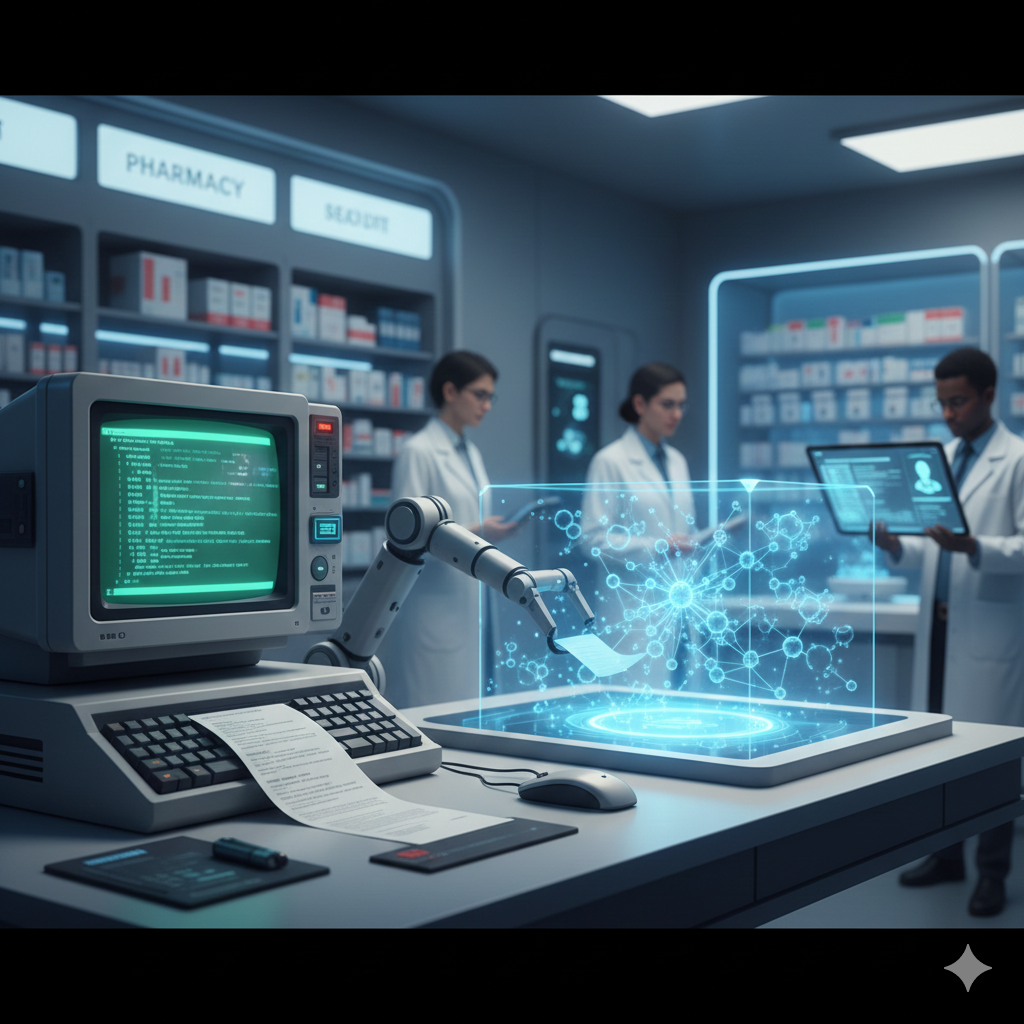
That first computerized prescription in 1983 set off a wave of digital curiosity. Early systems were slow, clunky, and expensive, often requiring pharmacists to navigate green screens and command lines. But they laid the groundwork for the digital ecosystems we now take for granted.
By the early 1990s, pharmacy management systems (PMS) began integrating core functions such as inventory, billing, and refill reminders. These were the humble beginnings of automation. What once required manual ledgers and phone calls could now be tracked, processed, and billed with greater efficiency.
Fast forward three decades, and that same spirit of innovation has expanded the pharmacist’s role from dispenser to healthcare connector.
MTM: From Clunky to Clinical
When Medication Therapy Management (MTM) first launched under Medicare Part D in 2006, it was a paper-heavy, cumbersome process. Pharmacists were asked to perform comprehensive medication reviews, document interventions, and submit care plans often without integrated systems or reimbursement clarity.
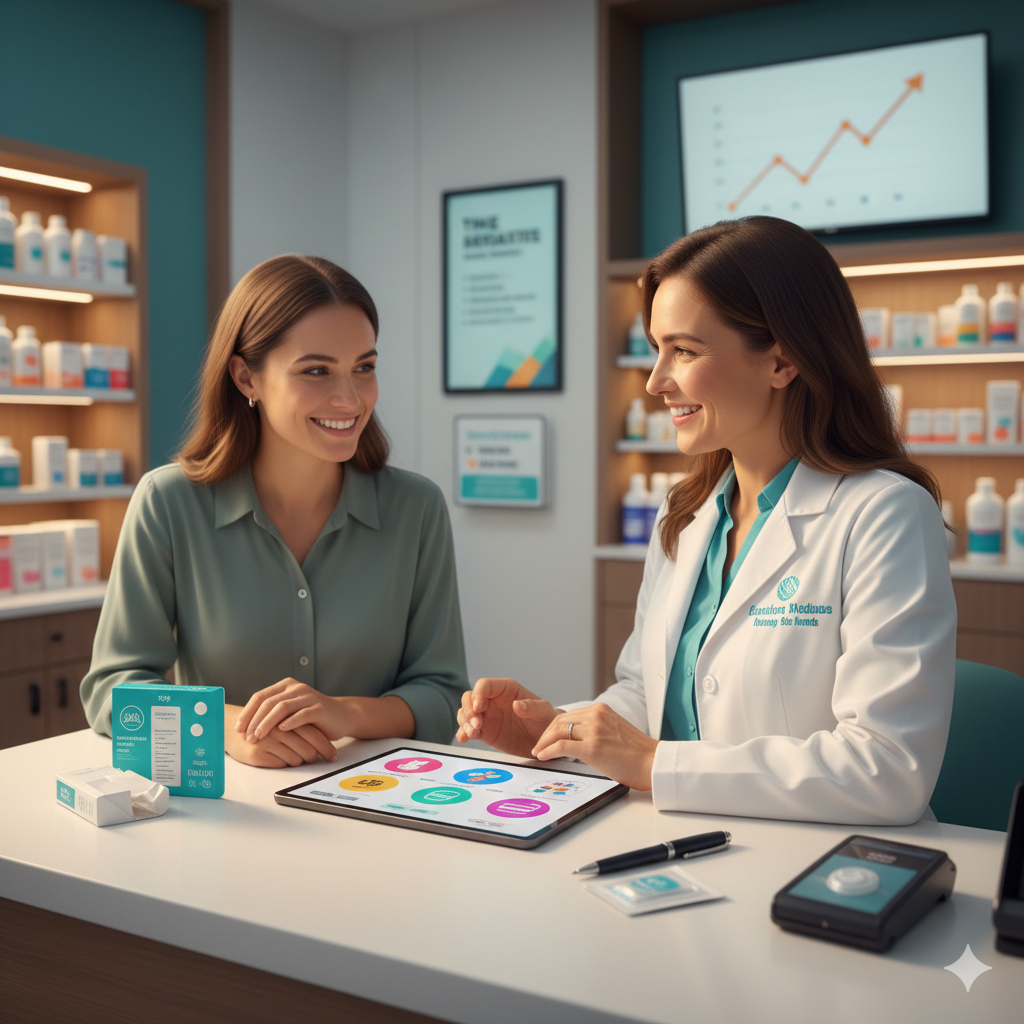
Today, MTM programs are woven into the digital fabric of pharmacy practice. Platforms like Outcomes and EnlivenHealth have transformed what was once an administrative burden into a seamless clinical opportunity. Pharmacists can now identify eligible patients directly in their PMS, communicate with prescribers and patients, document interventions, and submit encounters electronically. The result? More consistent follow-up, better documentation, and tangible proof of the pharmacist’s impact on therapeutic outcomes. What was once “extra work” is now a cornerstone of clinical pharmacy.
Medicare Open Enrollment: From Manual to Machine Learning
Every fall, community pharmacies brace for the annual Medicare Open Enrollment rush, a season of comparison, confusion, and counseling. Twenty years ago, this process meant sitting down with a patient, typing plan data manually into CMS tools, and cross-referencing formularies by hand.
Today, technology does the heavy lifting. Modern plan-comparison tools pull live CMS data, automatically tailor plan options based on each patient’s medication profile, and generate side-by-side cost comparisons in seconds. Some systems even integrate predictive analytics suggesting the most cost-effective plan not only for today’s drug list but based on expected utilization trends. For pharmacists, this means less data entry and more patient engagement. It turns a traditionally administrative service into a high-value, trust-building consultation that strengthens patient loyalty.
Immunization Integration: From Paper Logs to Smart Scheduling
The pandemic forced healthcare to rethink access, and community pharmacy stepped into the spotlight. But the groundwork for this moment was built years before through steady improvements in immunization workflow technology.
Once upon a time, pharmacies kept handwritten logs, printed consent forms, and reported doses manually to public-health registries. Today, immunization modules are integrated directly into PMS platforms, allowing for automated patient eligibility checks, online scheduling tied to real-time availability, and one-click registry reporting that satisfies both state and federal requirements.
These systems didn’t just make workflow easier—they helped solidify the pharmacist’s position as a frontline healthcare provider. Technology gave pharmacists the tools to manage volume, ensure accuracy, and report outcomes at scale.
Medication Synchronization: The Pillar of Modern Pharmacy
Med Sync might be the most underrated technological advancement in community pharmacy. What started as a manual calendar and notebook concept evolved into a data-driven tool that has reshaped adherence strategies.
Originally, technicians would call patients, calculate days’ supply manually, and hope to sync refills accurately. Today, PMS-integrated Med Sync programs automate refill alignment, inventory management, and patient notifications while tracking adherence scores in real time. This transformation didn’t just simplify workflow it became a relationship engine. When refills are predictable, pharmacists can use that time to provide clinical services rather than chase prescriptions. Med Sync has become a keystone of operational efficiency and patient engagement.
Digital Push Notifications and Checkout: A New Communication Era
The next major leap forward was digital engagement. For years, pharmacies relied on phone calls and print marketing to reach patients. Then came the era of push notifications, text reminders, and digital checkout.
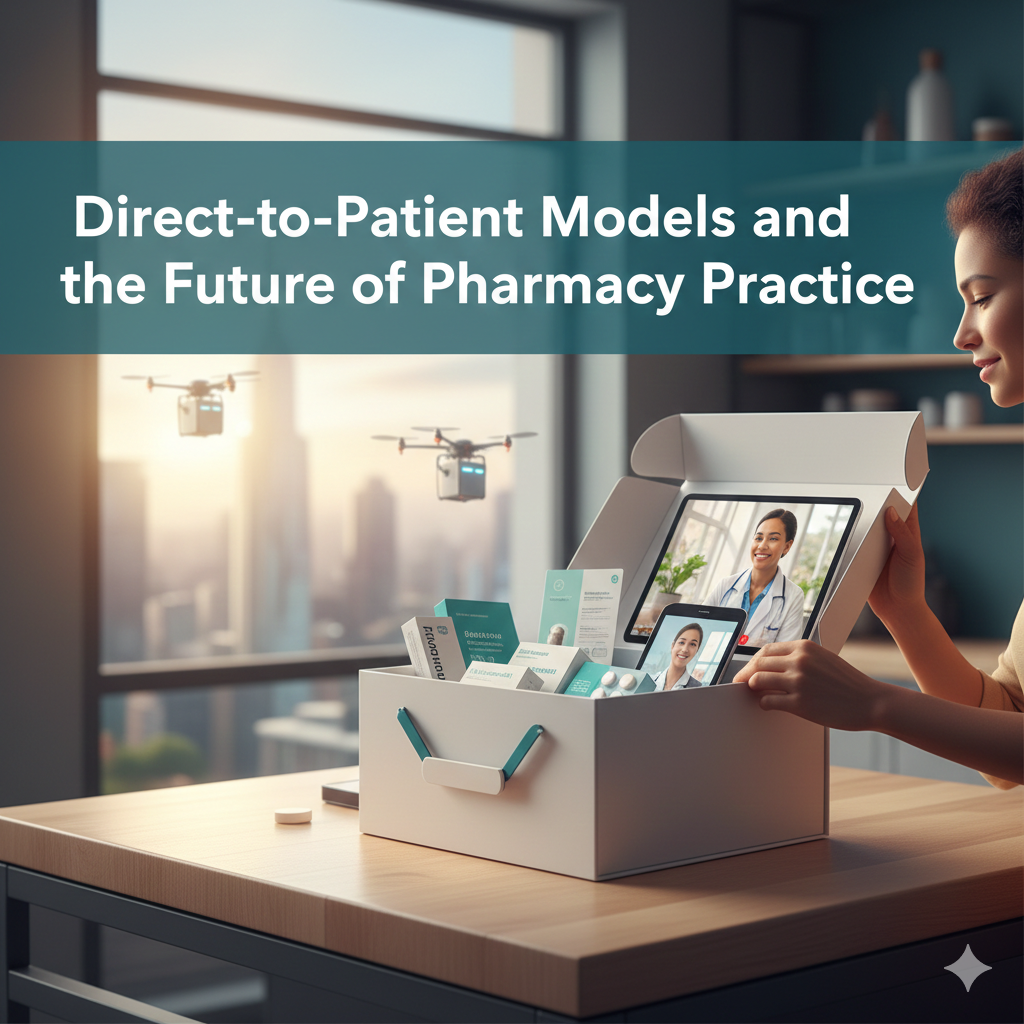
Today’s leading PMS and patient-engagement platforms allow pharmacies to send targeted health reminders, deliver personalized adherence nudges, and enable mobile checkout and curbside pickup all designed to meet patients where they are.
One standout in this space is Nimble, whose patient-facing app and messaging platform are built for a mobile-first world. Nimble reports an average 41% increase in refill volume per patient, 17% more prescriptions processed after hours, and a 15% boost in order size from OTC add-ons. Their platform sends refill alerts, provides one-click checkout via SMS, supports multimedia messaging, and maintains HIPAA compliance. For independent pharmacies, Nimble shows that push notifications and mobile checkout aren’t just conveniences they’re growth tools that convert engagement into measurable revenue and retention.
E-Care Plans: Proving the Value of the Clinical Encounter
For decades, pharmacists have been the only healthcare providers not routinely documenting patient interactions in a clinical format. The pill bottle was seen as proof of engagement. But as reimbursement models shifted toward outcomes-based care, that wasn’t enough.
Enter the E-Care Plan, the digital bridge between pharmacy and the broader care continuum. Modeled after the SOAP note used by prescribers, the E-Care Plan records the clinical rationale behind each intervention.
Now, pharmacists can record assessments, goals, and follow-ups in a standardized format, securely exchange data with physicians and payers, and demonstrate measurable impact. This technology is more than paperwork it’s proof of value. It positions the pharmacist not as a retailer, but as a care provider whose contributions are quantifiable and billable.
Clinical Billing: The Next Great Leap
With E-Care Plans in place, the next logical step is clinical billing integration. The future of pharmacy reimbursement lies in the ability to document, code, and bill for clinical services just as physicians do.
Clinical billing requires both mindset and system changes. Pharmacies need training on CPT coding, integrated billing modules that handle both medical and pharmacy claims, and workflows that make clinical care as natural as dispensing. Emerging solutions like Xifin, Outcomes, and EnlivenHealth are leading the way creating interoperable systems that blend dispensing, documentation, and billing into a single experience.
The end goal is simple but transformative: shift pharmacy’s revenue model from product-based to service-based. Community pharmacy becomes not just a place to pick up meds, but a destination for managing disease, optimizing therapy, and improving outcomes.
A.I. Integration: Pharmacy’s Next Frontier
If the past decade was about digitization, the next will be about intelligence. Artificial Intelligence (A.I.) is poised to reshape every facet of pharmacy practice from patient engagement to supply-chain optimization.
Imagine predictive adherence models that identify at-risk patients before they miss refills, automated therapy reviews that flag interactions in real time, and natural language tools that transcribe and code clinical encounters automatically.
Platforms like Pharmacy Marketplace are beginning to bridge this frontier, using A.I. to analyze purchasing behavior, predict drug movement, and guide smarter inventory and clinical decisions. This kind of integration allows pharmacists to connect financial, operational, and clinical insights in one viewturning data into decisions that strengthen both patient outcomes and profitability.
A.I. won’t replace the pharmacist it will empower them. The human touch remains irreplaceable; technology simply removes barriers so pharmacists can focus on what truly matters: caring for patients.
Learning from the Past, Leading into the Future
The same skepticism that met the first computerized prescription is being echoed today around automation and A.I. Some still say, “It’s unnecessary. It takes away from patient care.” But if history has taught us anything, it’s that technology doesn’t diminish the pharmacist’s role it amplifies it. Those who saw computers as a threat missed the bigger picture. Those who embraced them reshaped the industry.
The same will be true today. As new tools emerge, pharmacists must decide whether to resist or reinvent.
Be an Apple, Not a Blockbuster
Many businesses have refused to evolve because they couldn’t see where the ball or the puck—was headed. Blockbuster clung to physical stores as Netflix reimagined entertainment. Kodak hesitated on digital photography while competitors embraced it.
Pharmacy is standing at a similar crossroads. The community pharmacies that thrive in the next decade will be those that see change as opportunity, not threat. They’ll adopt new technologies early, integrate clinical services seamlessly, and measure success not by prescription count, but by patient outcomes.
In other words: Be an Apple, not a Blockbuster.
The Pharmacy of Tomorrow, Today
Looking back on the last 30 years of technological progress, it’s remarkable how far we’ve come from manual entry and handwritten logs to cloud-based platforms and A.I.-driven insights.
But this is just the beginning. The next chapter of pharmacy will be written by those who harness technology not for convenience, but for care. If we continue to evolve embracing MTM, E-Care Plans, clinical billing, and A.I.the future of community pharmacy is not only secure, it’s transformative.
Because the true heart of pharmacy has never changed. It’s still about helping people live healthier lives. Technology simply gives us more ways to do it better, faster, and smarter than ever before.