The pharmaceutical landscape is currently witnessing a tectonic shift as federal policy, aggressive private-sector innovation, and regulatory enforcement collide. In a single week, the launch of the government’s new “TrumpRx” portal and a sharp rebuke from FDA Commissioner Marty Makary against telehealth giant Hims & Hers have signaled a new chapter in the war over drug pricing and “copycat” medications. For stakeholders in the life sciences and telehealth sectors, the message is clear: the “Wild West” era of GLP-1 compounding is facing an imminent sunset.
The TrumpRx Launch: A Direct-to-Consumer Government Pivot
Last week, the White House officially unveiled TrumpRx.gov, a government-run platform designed to bypass traditional insurance hurdles and connect cash-paying patients directly with pharmaceutical manufacturers. The initiative is a cornerstone of the “Make America Healthy Again” (MAHA) agenda, focusing on radical price transparency.
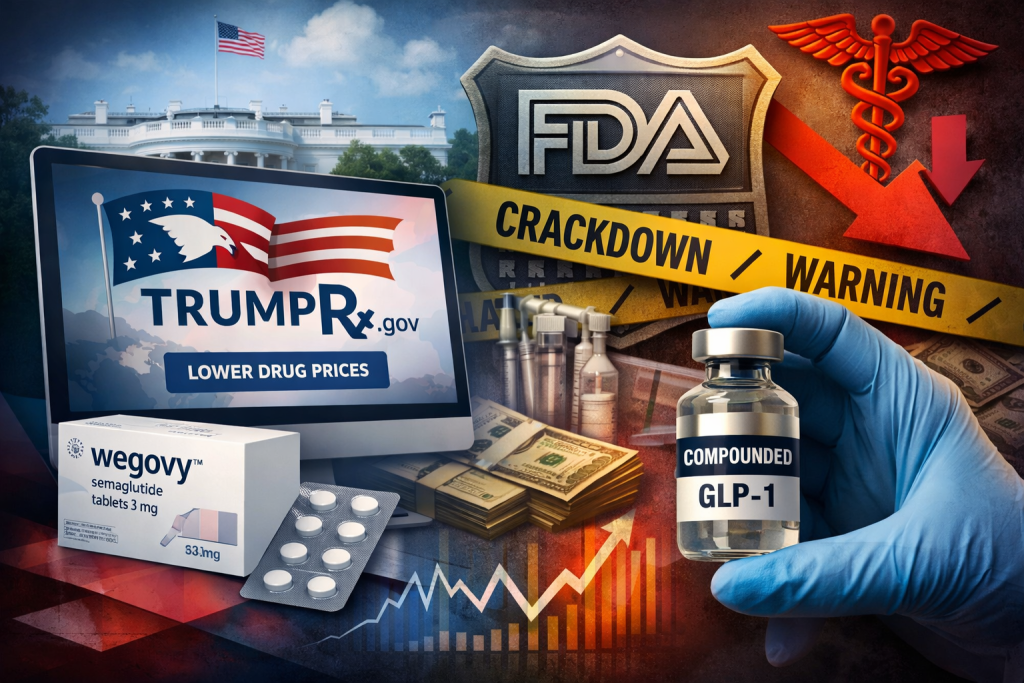
TrumpRx functions as a centralized clearinghouse, offering coupons and direct-purchasing channels. One of its marquee listings is Novo Nordisk’s newly approved Wegovy pill. By featuring branded GLP-1s at discounted rates for those paying out-of-pocket, the administration is attempting to lower the barrier to entry for life-saving medications while simultaneously reinforcing the value of FDA-approved products over cheaper, unverified alternatives.
The FDA’s Sharp Warning: A Crackdown on “Illegal Copycats”
The launch of TrumpRx coincided with a major escalation in regulatory rhetoric. FDA Commissioner Dr. Marty Makary recently issued a stern warning via social media and official channels, pledging a crackdown on the “mass marketing of illegal copycat drugs.” This statement was a direct response to Hims & Hers’ announcement of a compounded version of the Wegovy pill priced at just $49 per month, a third of the cost of the branded version.
The Commissioner’s concern centers on safety and the integrity of the approval process. Unlike traditional pharmacy compounding, where a pharmacist tailors a specific dose for an individual patient, the FDA views the large-scale manufacturing and aggressive digital marketing of these substances as “illegal mass compounding.” Dr. Makary emphasized that the FDA cannot verify the quality, safety, or effectiveness of these non-approved drugs, particularly when they use untested delivery mechanisms like liposomal technology instead of the proprietary SNAC technology used by Novo Nordisk.
The Compounding Conflict: Personalization vs. Mass Marketing
For the past two years, compounding pharmacies have filled a massive void created by GLP-1 supply shortages. Under federal law, pharmacies can compound versions of drugs that are on the FDA’s official shortage list. However, with supply chains stabilizing and Novo Nordisk’s Wegovy pill never having been on the shortage list to begin with, the legal ground for compounders is shifting.
Companies like Hims have pivoted to “personalization” arguments and claimed that their versions are different or “customized” for the patient. The FDA is no longer buying this defense since the doses are made in large quantities without any real personalization. The agency has signaled that it will treat these large-scale operations not as customized healthcare, but as the unlawful distribution of unapproved new drugs. This puts telehealth platforms and compounding pharmacies in a precarious legal position, as the FDA prepares to issue “untitled letters” and pursue enforcement actions in conjunction with the Department of Justice against misleading advertisements.
The Road Ahead for Life Sciences
The intersection of TrumpRx and the FDA crackdown creates a unique market dynamic. On one hand, the government is facilitating lower costs for branded drugs through direct-to-consumer portals. On the other, it is closing the door on the compounded alternatives that many patients turned to when brands were too expensive or unavailable.
For pharmaceutical marketers and telehealth providers, the “Golden Age” of regulatory flexibility is ending. The focus is shifting back to the rigorous standards of the FDA’s drug approval pathway. Companies must now navigate a landscape where digital ads are under a microscope and the definition of “compounding” is being narrowed to its original, patient-specific intent.
As the administration continues to promote TrumpRx as the solution to high drug costs, the pressure on manufacturers to participate in these direct-to-consumer models will grow. Simultaneously, the risk for those operating in the compounding space has never been higher. Navigating this transition requires a deep understanding of FDA compliance, the evolving definition of “mass marketing,” and the administrative law governing new federal platforms.
For help with complying with FDA expectations and avoiding DOJ scrutiny, please contact Darshan Kulkarni PharmD, MS, Esq. at the Kulkarni Law Firm, PC at 302.252.6959 or by visiting www.kulkarnilawfirm.com.

For more practical owner/operator guidance on pharmacy growth, operations, staffing, clinical services, and profitability, visit the Independent Pharmacy Resource Center.