What the FDA Just Clarified
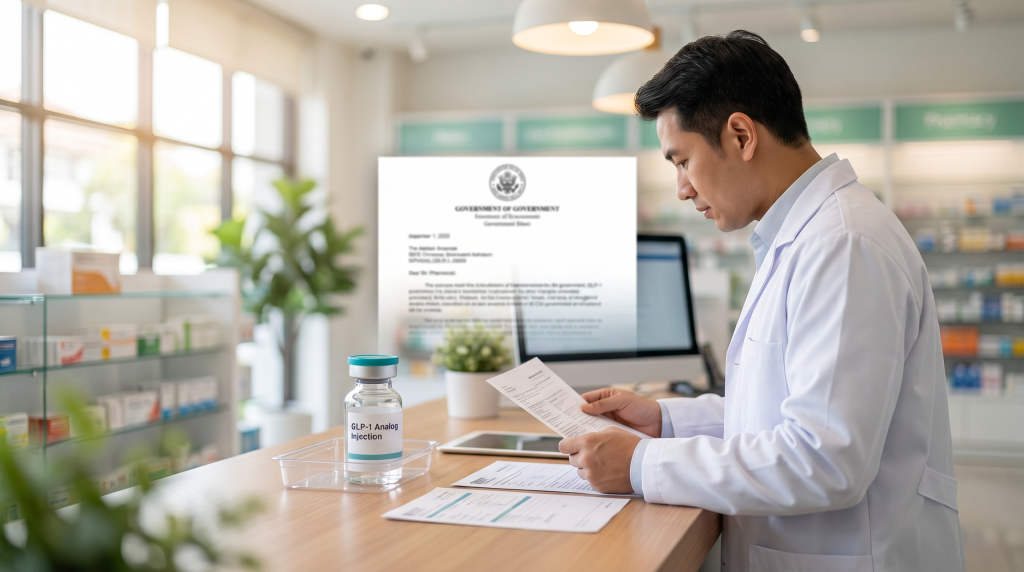
The regulatory landscape shifted decisively when the FDA published updated guidance detailing the boundaries of legal compounding for GLP-1 products. The agency established an unequivocal stance: compounding copies of commercially available, FDA approved drugs is strictly prohibited unless those specific drugs are currently listed on the official FDA drug shortages database.
Because both tirzepatide and semaglutide have been officially removed from the shortage list, the fundamental justification for widespread compounding of these medications has evaporated. The FDA emphasized that compounded GLP-1 drugs are not FDA approved, meaning they have never been evaluated for safety, efficacy, or quality by the agency.
Furthermore, the FDA issued a direct warning regarding marketing practices. Presenting compounded versions as equivalent to branded drugs like Ozempic, Wegovy, or Mounjaro is considered false and misleading. The agency has made it clear that regulatory action will follow for entities that continue to operate outside these clarified boundaries. This was detailed extensively in a recent legal analysis published by Mondaq, which highlighted the specific compliance hurdles now facing the industry.
Why GLP-1 Compounding Exploded
The surge in compounded GLP-1 medications was born out of a perfect storm of unprecedented consumer demand and severe supply chain failures. When manufacturers Eli Lilly and Novo Nordisk could not produce enough tirzepatide and semaglutide to meet the explosive market interest in medical weight loss, the drugs landed on the FDA shortage list.
This shortage designation triggered a regulatory mechanism designed to ensure patient access to critical medications. Under Section 503A and 503B of the Food, Drug, and Cosmetic Act, compounding pharmacies were legally permitted to produce copies of the branded drugs to fill the supply gap.
Entrepreneurs, telehealth platforms, and compounding pharmacies quickly recognized the opportunity. They built massive patient acquisition engines, offering compounded GLP-1s at a fraction of the cost of the branded alternatives. The market expanded rapidly, creating a parallel supply chain that served millions of patients who were either unable to find the branded drugs in stock or unable to afford their high retail prices.
What Counts as a “Copy” Drug
A central point of contention in the compounding industry has been the definition of a “copy” drug. Many compounders attempted to bypass the restrictions on copying commercially available drugs by altering the formulation slightly. The most common tactic was the addition of vitamins, particularly B12, or other supplements to the GLP-1 base.
The FDA has now unequivocally rejected this strategy. The agency clarified that a compounded drug is considered essentially a copy if it utilizes the same active pharmaceutical ingredient, the same dose, and the same route of administration as the commercially available product.
Adding an ingredient like vitamin B12 does not meaningfully differentiate the compounded formulation from the branded product in the eyes of regulators. Unless the prescribing physician can document a specific clinical need for the altered formulation for an individual patient, the product remains an illegal copy of an approved drug that is no longer in shortage.
The End of the Shortage Loophole
The resolution of the drug shortages marks the definitive end of the loophole that sustained the compounded GLP-1 boom. The FDA has transitioned from a posture of enforcement discretion, which tolerated mass compounding during the supply crisis, to a posture of active restriction.
This transition is not merely theoretical. In April 2026, reports emerged that the FDA had begun restricting compounded GLP-1 prescriptions, limiting pharmacies to a maximum of four monthly prescriptions for these specific copies. Simultaneously, the agency escalated its oversight, targeting the highest volume producers first.
Major 503B outsourcing facilities, which function as high capacity manufacturers within the compounding ecosystem, have reportedly halted GLP-1 production under direct pressure from the FDA. By curtailing the output of these massive facilities, regulators are effectively throttling the supply chain at its source, forcing the market to contract without immediately engaging in thousands of individual enforcement actions against smaller pharmacies.
What This Means for Pharmacies
The regulatory shift presents immediate and severe challenges for the pharmacy sector. The burden of production is now shifting away from the large 503B facilities and onto smaller 503A compounding pharmacies.
However, 503A pharmacies operate under entirely different constraints. They are limited by smaller batch sizes, rigorous individual testing requirements, and staffing limitations. Most well run 503A operations simply cannot scale rapidly enough to replace the massive output previously generated by 503B facilities.
For independent pharmacies, the environment is increasingly perilous. The liability associated with dispensing compounded GLP-1s has skyrocketed. Pharmacies must now ensure that every compounded prescription meets strict individual patient needs rather than functioning as a generic substitute for a branded drug. The days of bulk compounding these medications for general weight loss clinics are over.
Independent pharmacy owners should immediately audit their current compounding operations, consult with legal counsel regarding compliance with the updated FDA guidance, and evaluate whether their existing GLP-1 compounding revenue can be sustained under the new regulatory framework.
Impact on Telehealth Companies
The telehealth sector, which served as the primary distribution engine for compounded GLP-1s, is facing an existential threat. The FDA has already demonstrated its willingness to target these platforms, recently sending 30 warning letters to telehealth companies for illegally marketing compounded GLP-1s.
These letters specifically cited false and misleading claims, particularly the assertion that compounded products are equivalent to FDA approved drugs. Telehealth companies can no longer rely on the high volume, low margin model of prescribing compounded weight loss medications.
As the supply of compounded drugs tightens due to the exit of 503B facilities, telehealth providers will struggle to fulfill existing patient subscriptions. Fulfillment windows, which previously took days, are expected to stretch into weeks. This disruption in continuity of care will likely drive patient attrition and force telehealth platforms to pivot toward prescribing branded medications, which carry significantly higher costs and narrower profit margins.
The litigation landscape is equally hostile. Both Eli Lilly and Novo Nordisk are pursuing active lawsuits against telehealth providers, with the Lilly v. Mochi case now moving into discovery. This phase could expose prescribing patterns and operational practices across the entire telehealth compounding ecosystem, setting precedents that reshape the industry for years to come.
Legal and Compliance Risks
The legal risks surrounding GLP-1 compounding are escalating rapidly. Beyond FDA enforcement, the industry is facing scrutiny from multiple federal agencies. The Department of Health and Human Services Office of Inspector General has announced a formal investigation into the oversight of compounded GLP-1 drugs, signaling a broader federal crackdown that extends well beyond the FDA alone.
Furthermore, the original drug manufacturers are aggressively protecting their intellectual property and market share. Both Eli Lilly and Novo Nordisk are pursuing active litigation against telehealth providers and compounding pharmacies, alleging trademark infringement and the distribution of unapproved drugs.
Pharmacies and prescribers caught in this crossfire face the prospect of severe financial penalties, the loss of professional licenses, and potentially criminal liability if they are found to be intentionally circumventing FDA regulations. The SAFE Drugs Act of 2025, which proposes tighter restrictions on 503A pharmacies compounding copies of FDA approved drugs and expanded FDA oversight, could further narrow the legal pathways available to compounders.
What Happens Next
The immediate future of the GLP-1 market will be characterized by significant supply disruption and market contraction. While existing inventory in the distribution channel may temporarily mask the impact of the 503B facility shutdowns, a supply bottleneck is inevitable.
In the short term, patients and providers should expect reduced availability of compounded GLP-1 medications. Fulfillment timelines will extend, and some telehealth platforms may be forced to pause new patient enrollment entirely.
In the mid term, enforcement and audits will intensify. The FDA will likely continue its targeted strategy, focusing on high visibility telehealth platforms and large scale compounders before moving downstream to individual prescribers and smaller pharmacies. The HHS OIG investigation will add another layer of federal scrutiny.
In the long term, the market is consolidating toward FDA approved manufacturers and compliant distribution channels. Novo Nordisk has already launched a Wegovy subscription model designed to capture patients transitioning away from compounded alternatives. Eli Lilly is expected to pursue similar direct access strategies.
Patients who rely on compounded options because branded alternatives remain financially out of reach will face the greatest burden. As legal access pathways constrict without a corresponding improvement in affordability, there is a substantial risk that patients will turn to unregulated gray markets or illicit online sources to secure their medications.
Industry Shift: From Opportunity to Enforcement
The era of unrestricted GLP-1 compounding has concluded. The market is experiencing a forced consolidation, driving patients and providers back toward FDA approved manufacturers and compliant channels.
For compounding pharmacies, the focus must shift immediately from aggressive expansion to rigorous compliance. The business models that thrived during the shortage are no longer viable. Survival in this new regulatory environment requires strict adherence to Section 503A requirements, meticulous documentation of individual patient needs, and a complete cessation of mass marketing compounded copies of approved drugs.
For telehealth platforms, the path forward requires a fundamental restructuring. Companies that built their entire value proposition around affordable compounded GLP-1 access must now find alternative revenue streams or negotiate partnerships with branded manufacturers to maintain patient relationships.
For independent pharmacies, this moment demands strategic clarity. Those with established compounding capabilities should evaluate whether pivoting to other compounded medications or clinical services offers a more sustainable path than attempting to navigate the increasingly hostile GLP-1 regulatory environment.
The FDA has drawn a definitive line. The industry must now navigate the reality of strict enforcement, where the penalties for non-compliance far outweigh the temporary profits of the shortage era. The pharmacies and providers that adapt quickly will survive. Those that do not will face consequences that extend far beyond lost revenue.
For more practical owner/operator guidance on pharmacy growth, operations, staffing, clinical services, and profitability, visit the Independent Pharmacy Resource Center.